Digital resources in the Social Sciences and Humanities OpenEdition Our platforms OpenEdition Books OpenEdition Journals Hypotheses Calenda Libraries OpenEdition Freemium Follow us

“Sures Migrantes” seminar on Italian-Brazilian ice-cream makers in Germany – 29 October

The ACE project is pleased to support the next session of the online seminar Sures Migrantes. The seminar is coordinated by our team member Thales Speroni (Centre Norbert Elias/CNRS), together with Revista Périplos and the CLACSO Working Group on South-South Migrations and Borders. On 29 October, psychologist Diane Portugueis and journalist Stéphanie Mercier will discuss a case at the heart of our research: Brazilians of Italian descent who use their Italian passports to work seasonally in Germany’s ice-cream parlours.
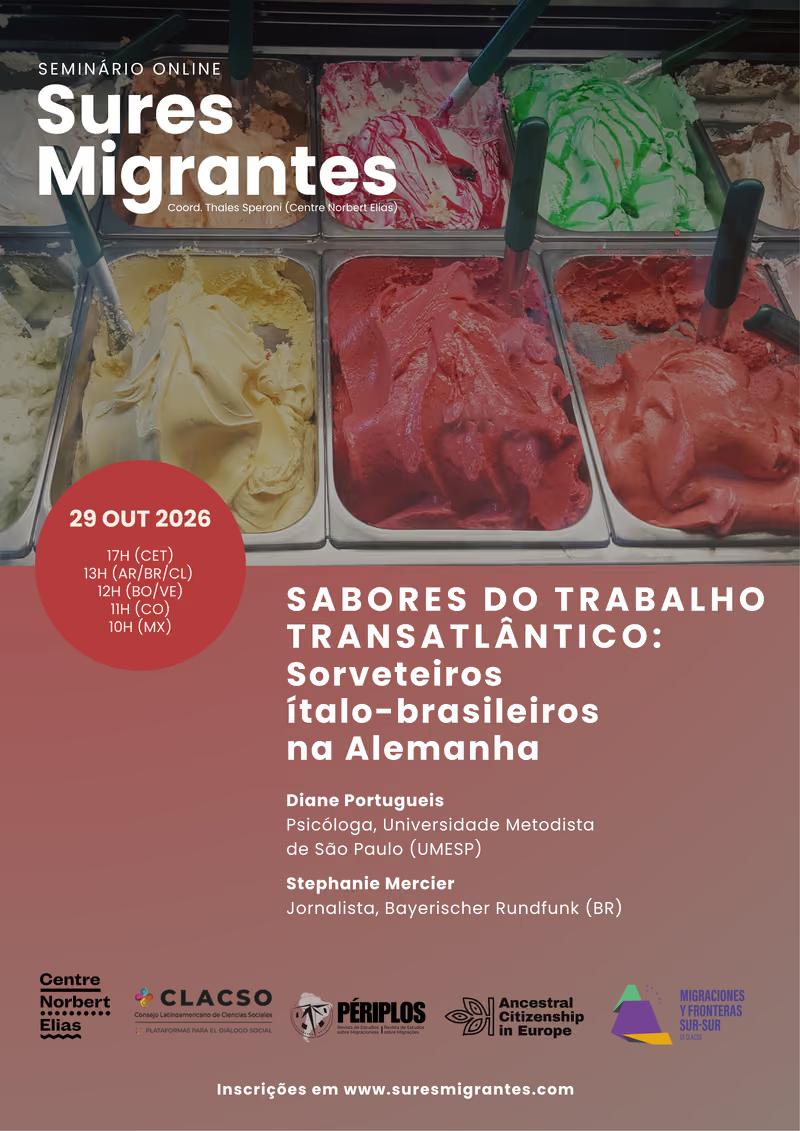
About the session

Every March, thousands of Brazilians from southern Santa Catarina leave for Italian-owned ice-cream parlours in Germany, returning only in October. The circuit has an unlikely origin. The 1963 Vajont disaster destroyed Longarone and killed nearly two thousand people. It reconnected survivors with emigrant descendants across the Atlantic and led to the 1991 twinning of Longarone (Italy) and Urussanga (Brazil). Soon afterwards, that reunion turned into a labour recruitment route.

Although legally European, these workers live much like non-EU nationals. They face twelve-hour days, housing that comes with the job and almost no inspection of their working conditions. The economic plan often pays off, with a house, a car and upward mobility. The biographical and emotional balance rarely adds up. What remains is a liminal condition with no end date, whose psychological costs reach both those who leave and those who stay behind. Among them are the so-called “orphans of Urussanga”, children raised by grandparents and neighbours.

The session brings Diane Portugueis’s long-term ethnography together with Stéphanie Mercier’s investigative reporting. It asks what academic research and investigative journalism can do for each other to make visible migrations that have remained unnamed and uncounted for decades.

Speakers

Diane Portugueis is a psychologist and professor at the Universidade Metodista de São Paulo (UMESP). She holds a PhD in Social Psychology from PUC-SP, completed under joint supervision with the Institute for Migration Research and Intercultural Studies (IMIS) at Osnabrück University. She is the author of Vidas em trânsito: sorveteiros ítalo-brasileiros entre Itália, Alemanha e Brasil como (não) lugares (Paco Editorial, 2024), which she will present during the session.

Stéphanie Mercier is a French-German journalist at Bayerischer Rundfunk (BR) in Munich. Her investigation into Brazilian workers in Germany’s ice-cream parlours took her from Bavaria to southern Brazil and Italy. It led to a feature in the Süddeutsche Zeitung Magazin in August 2026.

  • Date: Thursday, 29 October 2026, 17:00 CET (13:00 in Brasília, Buenos Aires and Santiago; 12:00 in La Paz and Caracas; 11:00 in Bogotá; 10:00 in Mexico City)
  • Format: online, free of charge
  • Language: Portuguese

ACE Project Meeting and Writing Workshop in Marseille

From 6 to 9 October 2026, the ACE team gathered in Marseille for a Project Meeting and Writing Workshop, hosted by the Centre Norbert Elias at the Centre de la Vieille Charité. The meeting brought together researchers from the three partner institutions to reflect jointly on the work carried out so far in Germany, Italy and Bulgaria.

The workshop pursued three aims. The first was to advance the comparative dimension of the project, bringing the three country cases into closer dialogue. The second was to build, collaboratively, an interpretive framework able to connect the different levels of analysis and the empirical cases. The third was to develop the collective publications through which the project will present its results.

Over four days, the team alternated between discussion and writing, combining plenary sessions with work in smaller groups. These exchanges helped to identify what the cases share, to clarify where they differ and to refine the concepts used to describe them. Time was also given to the next steps of the project.

The team leaves Marseille with common reference points for the comparison and a clear direction for the collective writing ahead.

The workshop brought together Melissa Blanchard and Thales Speroni (CNRS, Centre Norbert Elias), Zeynep Yanaşmayan and Jonna Rock (DeZIM) and Zeynep Kaşlı and Marhabo Saparova (ISS, Erasmus University Rotterdam).

We are grateful to the Centre Norbert Elias for its hospitality and to the Volkswagen Foundation, which funds the ACE project.

Photos by Virginia Girod-David, Centre Norbert Elias

New Publication by Melissa Blanchard and Thales Speroni

We are pleased to announce the publication of a new article by Melissa Blanchard, Co-PI of the ACE project, and Thales Speroni, postdoctoral researcher on the ACE project, in the Journal of International Migration and Integration.

Blanchard, M., & Speroni, T. (2026). From roots to routes (and back)? Unexpected narratives of Italian ancestral citizenship acquisition. Journal of International Migration and Integration. https://doi.org/10.1007/s12134-026-01427-5

Drawing on multisite ethnographic fieldwork and 23 in-depth interviews conducted between October 2023 and April 2025 with Brazilians of Italian descent who acquired Italian citizenship and migrated to Italy, Spain or the United Kingdom, this article examines how citizenship acquisition, ancestry and migration intersect in individual biographies.

The analysis reads these narratives alongside Italian citizenship legislation and parliamentary debates on jus sanguinis. Until the reform enacted in March 2025, Italian law allowed descendants of emigrants to claim citizenship without generational limits, implicitly assuming a linear sequence running from ancestry to citizenship and, possibly, return migration to the ancestral homeland. Blanchard and Speroni identify three biographical configurations — ancestry first, citizenship first, and migration first — that depart from this expectation.

They argue that ancestry (understood by participants as an emotional attachment to family roots rather than as mere legal filiation), citizenship and migration operate as an interconnected triangle rather than as a straightforward progression. Situating these trajectories against the 2025 reform, which limits transmission to two generations and makes territorial links to Italy a condition of belonging, the article shows that the mismatch between lived trajectories and legal expectation illuminates not only what citizenship means to individuals, but also how the state conceives its own membership.

Access the full text here: https://rdcu.be/fzZXk

The First Cycle of ACE Dialogues: Going Back to Go Forward Is Now Complete

Over the past months, the ACE Dialogues series brought together scholars from across the globe to explore one of the most compelling and underexamined phenomena in contemporary migration studies: ancestral citizenship. From colonial histories to wartime nation-building, from diaspora policy to return migration, each session offered a distinct window into how states and communities negotiate identity, belonging, and membership across borders and generations.

Here is a look back at the five sessions that shaped this first cycle.


Session 1 | November 4, 2025 Seeing Like a Racial State: The Colonial and Racial Capitalist Roots of German Citizenship Sabrina Axster (Cornell University)

Sabrina Axster traced the making of Germany’s 1913 citizenship act back to its colonial and racial capitalist roots, arguing that citizenship laws were not merely tools of state-building but instruments designed to manage land, labor, and racial boundaries across the empire and its metropole.

Watch the recording:


Session 2 | December 2, 2025 Ancestral Citizenship as Postcolonial Redress: The Case of Puerto Rico and Spain Marielys Padua Soto (American University in Cairo)

Marielys Padua Soto examined whether ancestral citizenship laws can function as instruments of reparative justice, focusing on Puerto Rico’s historical and legal relationship with Spain and comparing it with other restitution cases, including Spain and Portugal’s nationality laws for Sephardic Jews.

Watch the recording:


Session 3 | February 3, 2026 The Ancestral Imperative: How War Is Redefining Ukrainian Citizenship Beyond Territory Olga Poiedynok (Taras Shevchenko National University of Kyiv)

Olga Poiedynok argued that Russia’s ongoing war of aggression has been a catalyst for a fundamental shift in Ukraine’s approach to citizenship, moving from a territorial model toward a de-territorialised, nation-centric framework that redefines the Ukrainian nation as a global, networked community.

Watch the recording:


Session 4 | March 10, 2026 The Karta Polaka As An Act Of Recognition Of (Non-)Citizens: A Case Study Of Diaspora In Eastern Europe Eugeniusz Kuźnicow-Wyszyński (University of Warsaw)

Eugeniusz Kuźnicow-Wyszyński explored the Karta Polaka as a form of ancestral citizenship in motion, showing how this legal instrument places holders of Polish descent in a liminal space between foreigners and nationals, and what this reveals about the politics of extraterritorial nationhood and symbolic inclusion.

Watch the recording:


Session 5 | April 7, 2026 | Closing Session Integration and Belonging: The Case of Repatriated Kazakhs from Uzbekistan, China, and Mongolia Zhuldyz Zhumashova (Texas A&M University)

Zhuldyz Zhumashova closed the cycle by examining the lived experiences of Qandas, ethnic Kazakhs who returned to Kazakhstan following the state-led repatriation initiative of 1992, and how their sense of belonging and societal acceptance has evolved over time across communities originally based in Uzbekistan, China, and Mongolia.

Watch the recording:


We are grateful to all the speakers, participants, and collaborators who made this first cycle of ACE Dialogues a rich and stimulating conversation. Stay tuned for future events from the ACE project!

Watch now the ACE Dialogues Closing Session

During our closing session, “Integration and Belonging: The Case of Repatriated Kazakhs from Uzbekistan, China, and Mongolia,” Zhuldyz Zhumashova from Texas A&M University delivered a compelling presentation on return migration, national identity, and the politics of belonging in Kazakhstan.

Her research examines the experiences of Qandas, ethnic Kazakhs who have returned to their ancestral homeland following the state-led repatriation initiative launched in 1992. Drawing on qualitative interviews, surveys, and policy reviews, the presentation explored how returnees from Uzbekistan, China, and Mongolia have navigated shifting dynamics of social exclusion and gradual accommodation over the decades, and how their sense of belonging has evolved within Kazakh society.

The discussion offered thought-provoking insights into the intersections of ancestral citizenship, diaspora identity, and nation-building in Central Asia, highlighting the role of inclusive cultural policies and sustained community dialogue in shaping integration processes.

The recorded presentation is now available for viewing.

Watch the full recording:

ACE Dialogues Closing Session: Return Migration, Identity, and Belonging in Kazakhstan

April 7, 2026 | 13.00-14.00 (CEST)

Integration and Belonging: The Case of Repatriated Kazakhs from Uzbekistan, China, and Mongolia

Zhuldyz Zhumashova (Texas A&M University)
Webinar Link

Abstract: In 1992, Kazakhstan’s then-President Nursultan Nazarbayev called for Kazakhs abroad to return to their ancestral homeland. This state-led initiative has since facilitated the return of nearly two million ethnic Kazakhs. However, the integration of these returnees—often referred to as Qandas—into Kazakh society has been uneven, shifting over the years from social exclusion to gradual accommodation. This research explores the evolving experiences of returnees from Uzbekistan, China, and Mongolia, focusing on how their sense of belonging and societal acceptance have transformed over time. Drawing on qualitative interviews, surveys, and policy reviews, I examine the ways return migration intersects with notions of ancestral citizenship, national identity, and the politics of belonging. The study underscores the importance of inclusive cultural policies and sustained community dialogue in shaping integration processes.

Bio: Zhuldyz Zhumashova is a Ph.D. student in the Department of Anthropology at Texas A&M University. She also holds a Ph.D. in Cultural Studies from Al-Farabi Kazakh National University. Her research focuses on migration, diaspora, and nation-building in Central Asia, with a particular emphasis on ethnic return migration to Kazakhstan.

Lecture at Carleton University: “Ancestral Citizenship in Europe: From National Roots to Migratory Routes?”

On April 14, 2026, ACE team member Thales Speroni will deliver a guest lecture at Carleton University’s Jean Monnet Centre of Excellence in Ottawa, Canada.

The lecture will examine how several EU member states grant citizenship to descendants of emigrant populations abroad and what this means for understandings of national and European belonging. It will address how extraterritorial access to citizenship reshapes visions of Europe across generations, with a particular focus on the Italian case and the frictions between normative expectations embedded in citizenship law and the actual migratory projects of recently recognized citizens.

Date: Tuesday, April 14, 2026, 3:00 to 4:30 PM

Location: Room 3228, Richcraft Hall, Carleton University (Ottawa, Canada)

Registration (in-person only): https://carleton.ca/ces/cu-events/jmce-lecture-ancestral-citizenship-in-europe-from-national-roots-to-migratory-routes-with-dr-thales-speroni/

New Publication by Melissa Blanchard

We are pleased to announce the publication of a new article by Melissa Blanchard, Co-PI of the ACE project in the History and Anthropology Journal.

Blanchard, M. (2026). New generations, old practices? Mobility, crisis and intergenerational transmission in migrations between Argentina and Italy. History and Anthropology, 1–12. https://doi.org/10.1080/02757206.2026.2644212

Drawing on over a decade of ethnographic fieldwork in Trentino with families of Argentine descent, this article explores how migration functions as a recurring, intergenerational strategy within Argentinian families of Italian origin. Through the life stories of descendants who have “returned” to Italy, a country most of them never lived in, Blanchard examines the interplay between economic and political crises, family memory, and the strategic use of Italian citizenship acquired through ancestry. The article shows that it is not crisis alone that triggers reverse migration, but rather its intersection with social age, class, and generational experience of emigration. Migration, far from being a rupture, emerges as a thread of continuity across generations: one generation envisions it, another carries it out, and together they build a shared repertoire of resources, including memory, mobility, and citizenship, to navigate an uncertain future.

Access the full text here: https://www.tandfonline.com/eprint/HYDRKYEDVZ3IZ5PZWWHS/full?target=10.1080/02757206.2026.2644212#d1e103

The video recording of the 4th ACE Dialogues Session is now available

During our recent session, “The Karta Polaka and the Question of (Non-)Citizenship,” Eugeniusz Kuźnicow-Wyszyński from the University of Warsaw delivered a comprehensive presentation on ancestral citizenship and the Polish diaspora in Eastern Europe.

His research examines the Karta Polaka (Polish Card), a unique legal instrument that grants privileges to individuals of Polish descent without automatically conferring citizenship. The discussion offered valuable insights into how this policy establishes a liminal category between foreigners and nationals, and how it contributes to broader debates on extraterritorial nationhood and symbolic inclusion.

A message from the organizing committee: Regrettably, the fourth ACE Dialogues Session was interrupted ten minutes before its scheduled conclusion due to an emergency evacuation alarm. The organizing committee confirms that Eugeniusz Kuźnicow-Wyszyński is safe and unharmed. We deeply lament this distressing disruption and the dangerous trajectory the world is currently following.

Despite the premature conclusion, the recorded presentation remains highly informative and is now available for viewing up to the point of interruption.

Watch the full recording:

Fourth ACE Dialogues Session: The Karta Polaka and the Question of (Non-)Citizenship

ACE Dialogues Continues: The Karta Polaka and the Question of Recognition
The Ancestral Citizenship in Europe (ACE) project is pleased to announce the fourth session of its webinar series, ACE Dialogues: Going Back to Go Forward. ACE Dialogues examines ancestral citizenship — the practice of granting citizenship based on family heritage or as a form of historical restitution to people living abroad. As countries reconsider their migration policies and confront historical injustices, this series investigates how ancestral citizenship is reshaping migration patterns and challenging traditional notions of national belonging.

In this session, we will welcome Eugeniusz Kuźnicow-Wyszyński from the University of Warsaw, who will present “The Karta Polaka As An Act Of Recognition Of (Non-)Citizens: A Case Study Of Diaspora In Eastern Europe.” His research examines the Karta Polaka (Polish Card), a unique legal and symbolic instrument established by a 2007 law that grants individuals of Polish descent, primarily residing in former Soviet republics, a range of privileges. However, the card does not automatically confer legal citizenship, positioning its holders in a liminal category between foreigners and nationals.

Drawing from qualitative research, Kuźnicow-Wyszyński argues that the Karta Polaka represents a state-driven attempt to (re)define the contours of the Polish nation beyond its borders. By examining the Karta Polaka through the lens of ancestral citizenship in motion, this presentation contributes to broader debates on extraterritorial nationhood, symbolic inclusion, and the role of ethnic and historical criteria in shaping contemporary citizenship regimes.


Join Us!
March 10, 2026 | 13:00-14:00 (CET)
Webinar Link: https://univ-amu-fr.zoom.us/j/99080894230?pwd=P0CaZbHkC01fTdeXbmNWoOOX7jxlyr.1
Meeting ID: 990 8089 4230
Passcode: 329745